For as long as CAD has flowed into visualization tools, we have all accepted the same broken contract: import once, bake a mesh, throw the mathematics away. Guess the resolution wrong and you delete the scene, wait through the re-import, rebuild your materials, your lights, your cameras — and do it again. An entire industry normalized that loop.
Syntropix Studio is my refusal of that contract. It is a native, in-process engine for 3ds Max and Blender that treats CAD visualization as a procedural pipeline — the way Houdini treats effects — instead of a one-way conversion. Below is what that means architecturally, and why the combination of capabilities it ships does not exist elsewhere in this space.
The decision everything else follows from
Most tools in this category are converters. They read your file, produce a static mesh, and discard the source. Some run as standalone applications and push results through intermediate mesh files, which doubles memory pressure and strips renderer-specific material data on the way in.
Syntropix makes the opposite choice: the exact Boundary Representation (B-Rep) of every part is retained in host memory after import. The import is not a conversion — it is a first evaluation. The mathematical surfaces never leave the scene, so every downstream decision stays reversible.
1. Tessellation as a live parameter, not a bake
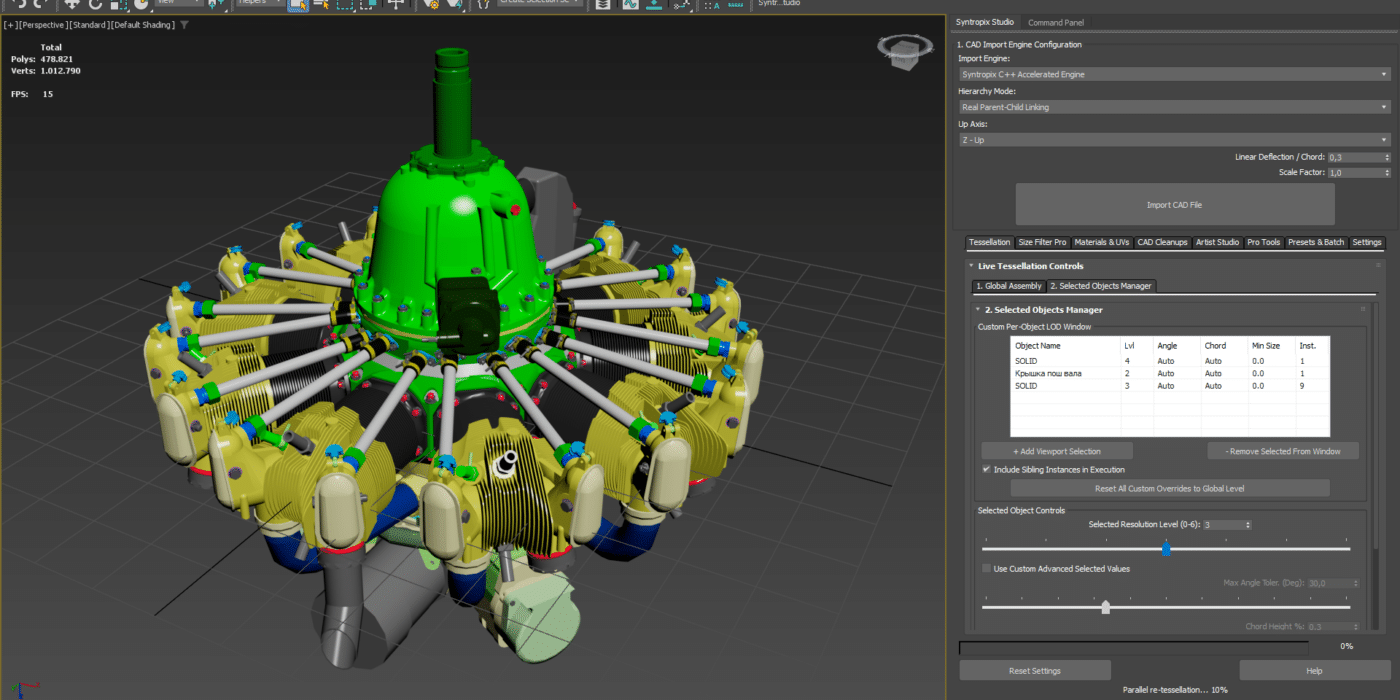
Chord height, angular deflection and per-object detail level are exposed as live parameters on the retained B-Rep. Change one and the engine re-evaluates the real surfaces in parallel across all available cores, then rebuilds only what changed.
- Global control — one parameter set re-cooks the entire assembly for layout and lighting passes.
- Per-selection overrides — the Selected Objects Manager pushes chosen parts to full mathematical resolution while the rest of the scene stays light.
- Instance propagation — override one part and every identical instance across the assembly follows automatically.
Nothing is re-imported, because there is nothing to re-import. The source never left.
2. A graph, not a pile of parts
The engine parses the assembly as a directed acyclic graph and deduplicates repeated topology into a prototype registry: each unique shape is tessellated and stored exactly once, and every occurrence references that master. Memory and cook time scale with unique topology, not with occurrence count — which is how six-figure part assemblies remain workable on a standard workstation.
3. Atomic, non-destructive scene integration
Re-evaluated meshes are built off the main thread and swapped into the scene graph atomically, under suspended redraw. Materials, modifiers, lights, cameras and hierarchy are never touched by a quality change. The operation stays cancellable at any point, and the interface remains responsive throughout — the engine pumps the host message loop deliberately instead of freezing it.
4. Adaptive detail: not every part gets the same meal
Blanket tessellation gives every part an identical polygon budget, producing either a crawling viewport or a faceted render. Syntropix replaces that with per-part adaptive detail:
Your hero parts feast. Your fasteners diet.
Beyond tessellation: a full procedural pipeline
- Hierarchy intelligence — multiple structure modes, empty-component pruning, single-child collapsing, layer mapping.
- Topology & cleanup — CAD-aware detriangulation, border welding, live quad preview, internal-shell stripping.
- Material intent — automatic PBR assignment that reads what a part actually is (metal, glass, rubber), plus rule-driven corporate material libraries.
- Revision diffing — signature-based deltas between CAD revisions, so a V2 delivery shows exactly what changed without disturbing your scene setup.
- Delivery — LOD chains and collision proxies for real-time engines, exploded views with true direction vectors, and a browser-based client presenter.
Why this combination is unique
Taken individually, pieces of this exist elsewhere: some tools instance, some re-tessellate, some clean topology. What I have not found in any other tool is the combination: retained B-Rep, graph-based instancing, per-part parametric overrides with instance propagation, and atomic non-destructive integration — in one in-process engine, across two hosts. Converters bake. Standalone bridges round-trip. Scripted importers freeze. Syntropix was architected from the first line to do none of those things.
It has been validated on six-figure part assemblies, in-process, with a responsive UI and a cancellable cook — on ordinary workstation hardware, not a render farm.
What comes next
This post is the first in a series. Over the coming days I will publish deep-dives into each module of the pipeline — capability by capability — because the engine runs much deeper than one slider.
I built this through months of nights, weekends, crashed machines and rewritten architectures, because every time I watched a progress bar crawl through yet another re-import, something in me refused to accept that this was simply how the work gets done.
To everyone who told me CAD visualization would always be a one-way street in a rusty car: thank you for the fuel.
— Khaled Bouaraour
Creator, Syntropix Studio